
Sump pump installation
A replacement sump pump has to fit both the pit and the piping. How quickly water enters, how far it must rise and where it drains outside are more useful for choosing equipment than the horsepower on the old pump.
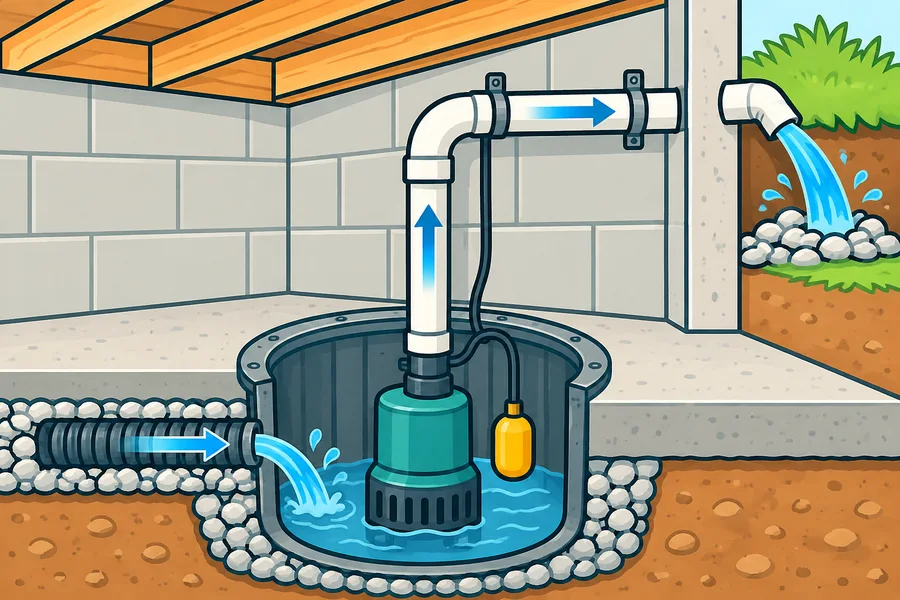
When the basin fills faster than it empties
Watch a cycle from a dry location. A rising basin with a silent pump raises different questions from a motor running while the water level barely falls. If the pit stays low while the floor gets wet, check whether the incoming water ever reaches the pit.
Water rises above the usual level
The pump may start late, fail to start or run without lowering the level. Observe from a dry location and leave electrical equipment in standing water alone.
The pump cycles repeatedly
Very short cycles or water rushing back into the basin after shutoff can point to float settings, a small basin or a check-valve issue.
Discharge returns toward the house
Water pooling near the foundation outlet can flow back toward the drain and make the pump handle the same water again.
Follow one pumping cycle
At the handover, ask the installer to demonstrate a normal start, discharge and shutoff. Knowing which part changed makes a later fault easier to describe.
- Basin and float
- Water from the drain raises the float, which calls for the primary pump to start.
- A rising level and a silent pump can indicate a switch, power or pump fault. Keep clear of electrical equipment in standing water.
- Primary pump and discharge line
- The water level falls during a cycle and water reaches the intended outdoor outlet.
- If the motor runs but the level keeps rising, have the outlet, piping and pump capacity checked. Listen for a change from the usual cycle.
- Check valve
- When the motor stops, the valve limits water returning from the discharge pipe.
- A large rush back into the basin followed by another start warrants a valve and piping check. Repeated short cycles can also result from the float setting or basin size.
- Battery backup
- A separately powered backup can move water when the primary is unavailable. An alarm tells you when attention is needed.
- Ask for a demonstration and the maker’s battery test schedule. Runtime depends on inflow, lift and battery condition.
Check where the cycle ends. Follow the manufacturer’s routine test instructions and keep the outdoor outlet clear through freezing weather. In Naperville, sump water cannot be discharged into the sanitary sewer or a basement floor drain. City discharge guidance.
Planning the pump and discharge route
Match the pump to the basin
Ask for the pump’s flow in gallons per minute at the proposed lift. A manufacturer’s performance curve shows how flow drops as the pump lifts water higher. Pipe length and bends also add resistance. The basin also needs space for the float and enough water between starts to avoid rapid cycling.
Connect collection and discharge
For a new basin, establish how foundation drainage will reach it. For an existing pit, check whether incoming drain openings are clear and whether discharged water runs back after shutoff. A dry basin beside a wet floor is a reason to investigate the collection path. See how basement drains feed a sump basin.
Check a complete pumping cycle
Confirm that the pump starts, lowers the water and shuts off, and that water reaches the intended outlet. Review power-loss options if the basin keeps filling during outages.
What to ask at the pump handover
- Keep the sizing information
- Ask for the model, its rated flow at your system’s lift, and the intended start and stop levels. Save the manual and a photo of the valve and outlet. These make future replacement simpler than matching horsepower alone.
- See the primary and backup operate
- Have the installer demonstrate a normal pump cycle and, if fitted, the backup and high-water alarm. Ask how failure of the primary is detected, where the alarm can be heard and how to recognize a charger fault.
- Schedule checks for this equipment
- Follow the maker’s instructions for pump testing and battery or charger checks. Review the outdoor outlet after landscaping and during freezing weather. A buried, crushed or frozen outlet can restrict discharge even when the motor runs.
Sump Pump Installation questions
Is a larger pump always a better replacement?
Capacity needs to fit the incoming flow and lift. An oversized pump in a small basin can cycle frequently, and a larger motor cannot correct a blocked outlet.
What does the check valve do?
It limits water flowing back down the discharge pipe after the pump stops. If water repeatedly falls back into the basin, the valve and piping are worth checking.
How long can a battery backup run?
Runtime varies with the battery’s condition, the backup pump and how often it cycles. Ask about performance at your actual lift and how to test and maintain the battery.
What is the difference between a water alarm and a backup pump?
An alarm alerts you when water rises to its sensor. A backup pump actually moves water if its switch, power source and outlet are working. Ask which functions the system includes and what happens when nobody is home to hear an alarm.
Does the whole basin need replacing with the pump?
An intact basin may be reusable if it receives the drain flow, provides enough depth and float clearance, and has an accessible cover. A cramped or damaged pit, or one that never receives the leaking water, changes the scope of replacement.
The pump runs during rain, but the wall under my window still leaks. Why?
The basin only collects water that reaches its inlets. Water coming through a window well or pipe opening can travel down the wall and onto the floor before it reaches a drain. Locate the first drip before assuming that a higher-capacity pump will solve it. Explore repair options for a localized basement leak.
Tell us about your basement.
Let us know whether you need a new basin or a replacement pump, and describe what happens during the heaviest rain.